
Fixed, Portable or Handheld? Choosing Under-Vehicle Inspection
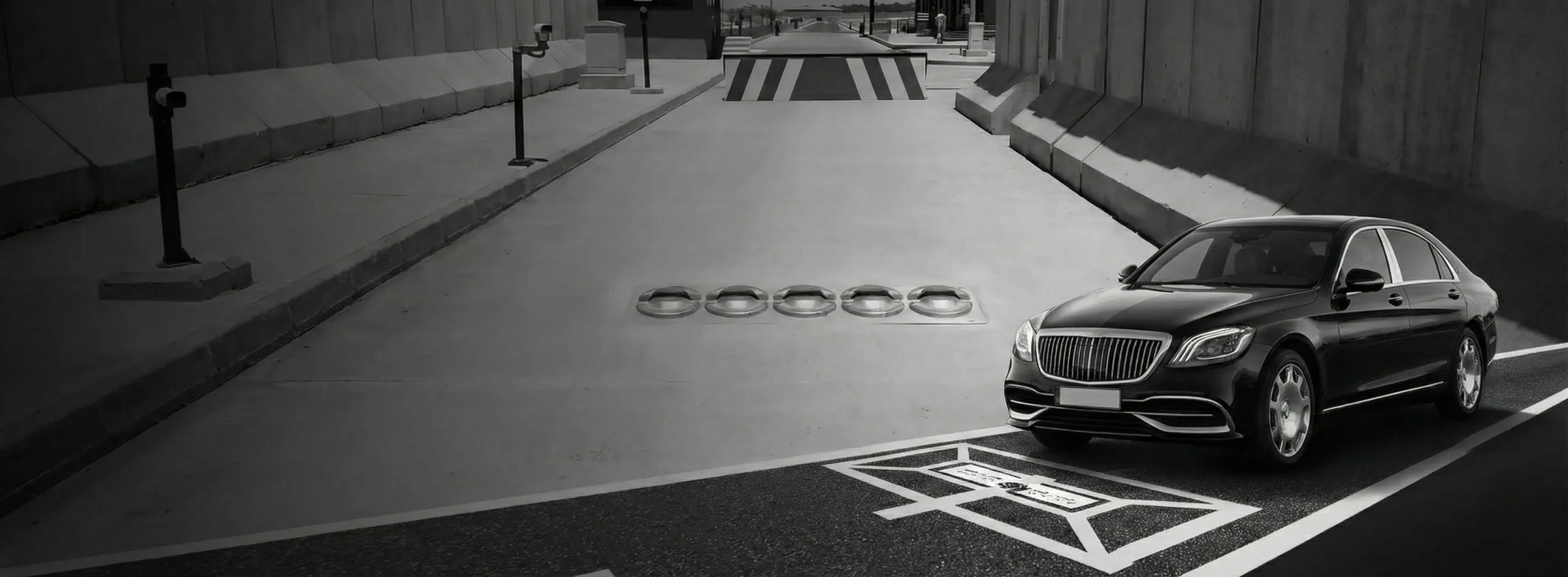
There are four ways to inspect the underside of a vehicle, and they are not substitutes for each other. The right one depends on how many vehicles pass, whether the checkpoint is permanent, how heavy the vehicles are and whether you need a record of every inspection. This guide sets out the four options and the questions that decide between them.
The four options
- Fixed in-ground UVSS — a permanent installation in the lane. The AS-UVSS-II is a fixed, in-ground system with about 20 MP colour imaging, a load capacity of at least 50 tons and integrated number-plate recognition (ANPR/LPR).
- Portable surface-mounted UVSS — rapidly deployable, with no excavation. The AS-UVSS-I is a colour UVSS for temporary or mobile checkpoints, with image capture in under one second and integrated licence-plate recognition.
- Handheld inspection camera — a person walks the vehicle. The Handheld DVR Inspection Cam has a 7-inch colour monitor, infrared illumination and on-board recording, starts in 1 second or less, extends on a telescopic pole from 1020 mm to 1780 mm and runs up to 12 hours on its battery at about 3.4 kg.
- Inspection mirror — the simplest check. The UV-Mirror-C Series is a wide-angle convex mirror with LED illumination and a telescopic handle, for quick manual checks without a record.
Questions that decide between them
How many vehicles pass, and is the flow continuous? A lane with steady traffic needs a system that scans without stopping the vehicle for long: that is what a UVSS is for. A checkpoint that sees a few vehicles an hour, or only at certain times, may be served by a portable UVSS or a handheld camera.
Is the checkpoint permanent? A fixed in-ground system needs civil works in the lane. A surface-mounted portable system does not, which is why it suits temporary, event and mobile checkpoints and sites where the lane cannot be dug up.
What is the heaviest vehicle? The AS-UVSS-II is rated for a load of at least 50 tons. For a portable system, confirm the load rating against your heaviest vehicle when you enquire; do not assume.
Do you need a record? A UVSS captures and stores images, and image comparison against earlier inspections helps spot a change; a mirror leaves no record, and a handheld camera records video. If inspections may be reviewed by others or by an authority, a stored image is worth having.
Do you need the number plate as well? Both UVSS models include integrated plate recognition, so the plate and the underside image belong to the same entry.
What are the conditions? Dark, wet or restricted places favour illumination: infrared on the handheld camera, LED on the mirror, and the lighting built into the UVSS.
Combining them
Many sites do not choose just one. A common arrangement is a fixed UVSS at the main gate for throughput and a handheld camera at secondary entrances and for a closer look at a vehicle the UVSS flags. A portable UVSS can cover an event, a construction phase or a second gate while a permanent one is planned.
What to send us
- The type of site and where the checkpoint is.
- The number of lanes, and the vehicles expected: cars, vans, heavy trucks.
- Whether the checkpoint is permanent or temporary.
- Power and network available at the lane, and any barrier or access-control system it should work with.
- Whether you need images recorded, and for how long.
Send these to our engineers through the contact page and we will recommend the system that fits. You can also read why the technology matters in Why Under Vehicle Surveillance Systems Are Essential for Modern Security and how Color UVSS technology improves inspection accuracy.
Planning an under-vehicle security project?
Our engineers can advise on the right system for your site.
sales@arvionsystems.com